September and October Visits

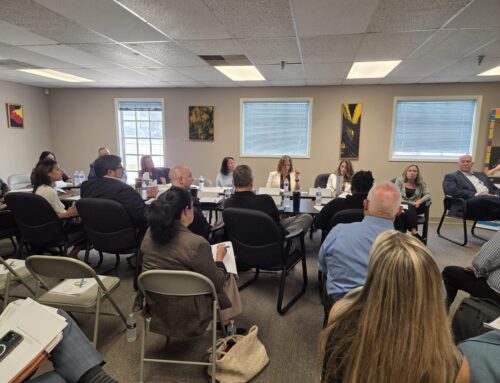
The Clinical Coordinator for CARES (Crisis Assessment Response and Enhances Services), Ke’Nesha Jones joined ABCD’s Residential Committee to present on Crisis Response and Intervention. Ms. Jones defined what a crisis is and how it differs from baseline behaviors (admitting that whether something is a crisis can often be in the eye of the beholder) as well as the difference between problem behaviors and psychiatric crises. She then provided guidelines for and examples of effective crisis responses and intervention strategies including what to avoid and warning that 70% of all communication is misunderstood. The value of post-crisis intervention and preparing a crisis plan which functions as a script for staff when this occurs is paramount. The meeting was chock full of valuable information.
Ms. Jones also joined ABCD’s Support Coordination Alliance to provide an overview of CARES, what it does, eligibility, mission, services, tools & strategies, project ECHO and what closes a case. CARES is free (grant funded by DDD), voluntary and has resources available in all counties. It is not a mobile screening service and cases are closed if the goals are met, housing is the primary issue, noncompliance with recommendations or services are declined. Project ECHO is an opportunity for providers to present challenging cases, receive recommendations and follow up services from staff. CARES has seen an uptick in the number of people it serves annually to between 1200-1400, which they are attributing to education about and improved. access to the service. CARES is seeing more young people. Individuals moving from their family home to a group home is a large cohort they serve. To decrease the need for CARES services during this transition, SCs are encouraged to have all supports in place from day one, fully educate the provider about the individual, encourage provider to help individual make the space their own. Sometime SCs need support which CARES can provide if requested. Referrals to CARES ca be made 24/7 and by calling 888.393.3007
Kate Yankitis, Director of Quality for DDD joined ABCD members to provide an overview of the new DSP training requirements which were developed based on the recommendations of the core competency workgroup. Kate reviewed all required training courses, communicating whether they were maintained, modified (and what that specifically means for each training designated as such), or new. Kate detailed the required training courses that are agency developed and those that will be available via CDS but may be developed by the agency, the latter of which will need to be pre-approved by the division. All training courses included in both categories have curriculum guidance elements which are outcome based, some of which will require competency testing and on the job mentoring. Several provider questions will be incorporated into future division communications; others will be reviewed and answered in the coming days. Our thanks to Kate for this valuable session which will help ABCD members to prepare for and be in compliance with the new requirements.
Jill Hoegel, Director of Investigations and Monitoring at Disability Rights New Jersey (DRNJ) visited both the Quality Assurance Forum and the Support Coordination Alliance to provide an overview of DRNJ’s history and services. For the QAF the questions centered around best practices and that DRNJ looks to ensure that planning is truly person centered, meaningful, and has measurable benchmarks. She said that compared to the other divisions they oversee in NJ, DDD’s internal review is very robust combining OPIA, CIMU and agency QADs, which is nice to hear. Biggest problem trend is the breakdown of communication and expectation breakdowns between agencies and family members and guardians. SCA and DRNJ discussed how an SCA that suspects systemic ANE can inform DRNJ. DRNJ also asked that whether the suspected ANE is individua or systemic, the SCA contact DRNJ first, since they may have additional information which might mean that the individual issue is systemic. When the individual needs legal support, DRNJ will provide information and referral to the SCA. To learn more about DRNJ visit their website at www.drnj.org